What in the world?? These are Stinkhorn Fungii. The first three or four appeared at this location September 20. We left for a week and upon our return, I found this amazing situation in this ONE site in this ONE area of our yard! I am Mystified!!
I have only seen one or two at a time, before. It seems, from my reading, stinkhorn fungi appear in composted soil and/or areas with commercial mulch (both of which appear in this little area, above). Perhaps you have seen a round fungal ball under the soil? I have seen these from time-to-time, with branching "rootlets." These in-the-soil balls are the "seeds" of stinkhorn fungi.
You can read this and more general information about these fungi here.
I may be less mystified, but... not completely!! Perhaps some of our recent weather conditions have contributed to the Numerous appearance of these fungi? (Yes, I have just read in other sources, that cool wet weather provides prime growing conditions for these fungi!)
Okay! Mystified by the appearance of so many, but not as Mystified by why they have occurred.
SG :-)
By the way, if you would like to read posts by other bloggers, click on the logo below.
Everything and more about gardening in Shady's SE Iowa (USA) location.
Wednesday, October 8, 2014
Wednesday, October 1, 2014
ABC Wednesday - L is Ligularia
During year number one, they were tiny seedlings needing nurturing. After the past two years' DROUGHT-filled summers, this year's rainfall has been a blessing! They loved the extra moisture and they all grew beautifully and bloomed!
As evidenced below.
As the flowers began to emerge, they looked like this!
And finally, like this!!
Just beautiful, don't you think?
However, I've been warned... and I see evidence... that they re-seed Very Easily.
Want some seeds? Send me an e-mail with your address!
Below we have Ligularia 'The Rocket'
This fellow really struggled last year... as ligularia desire good, rich Moist soil. This year, he did okay and did flower, but it wasn't the show seen in the photo above (taken in 2011).
Two weeks ago, I planted Ligularia 'Bottle Rocket.' He desires a little more sunlight, which he will get. He is supposed to grow 28-34" tall - photo of the plant below. We were gone last week. We didn't get the rain predicted, so the plant was pretty "sad looking" when I peeked at it this morning. A good watering and little rainfall improved its outlook. :-)
One more "L" photo - representing two more "L" words!
Leaf Litter!
It is now October 1, and Autumn leaves are beginning to fall! Hmmmm.
FYI: If you would like to enjoy ABC Wednesday posts by others, please follow This Link.
If these leaves continue to fall, it won't be Shady around here much longer! ;-)
SG
SG
Wednesday, September 24, 2014
ABC Wednesday - K for 'Krossa Regal'
An interesting hosta! (And one that begins with K!)
The next photo was taken just a couple of minutes ago. My 'Krossa Regal' experienced two years' extreme drought. This past growing season was wonderful, with ample rainfall, so he may return in better "splendor" next year!
You can see one leaf turning color. Often-times it develops an orange-yellow color in the Fall.
A fact I just read is that hostas grow well in city environments where the air may be polluted by car exhaust, etc. Something to consider, if you are an urban-dweller.
Kind of a "Broad (leaved) subject!"
Kudos to hosta breeders.
Kudos to 'Krossa Regal!'
Shady Gardener (Yep. It's a little dry, right now. It should rain before long, however.)
PS If you are wishing to visit posts by others participating in the ABC Wednesday meme, click on the logo below.
Tuesday, September 16, 2014
ABC Wednesday - J is for jardinière
According to Dictionary.com, Jardiniere is an ornamental receptacle or stand for holding plants, flowers, etc.
Okay! Thanks for joining the "Garden-Faire in Jardiniere!"
:-) SG
My Favorite Jardiniere....
a large, glazed ceramic pot! Located in my front garden bed.
By the way, the ONLY time the gaura, in the above photo, bloomed was when it was first planted! What's the deal??? Do you have any idea??
This jardiniere holds a variety of plants and was found in
Central Gardens, Clear Lake, Iowa.
The jardiniere below was found last year in the garden
of my friend, Nancy B!
(Black and Yellow - Iowa Hawkeye colors)
Does this qualify as a jardiniere?
These planters (and patio) were created by my brother.
Yes, the containers continue to get larger, it seems!
This "jardiniere" is found outside the home of my friend Carolyn S.
I found some very interesting jardinieres at my friend Dixie's house.
I created the following "jardiniere" from hypertufa.
The concrete mixture was placed over an upturned squirrel baffle. The nature of hypertufa allows rainwater to slowly seep through the container.
Enjoy the "fairy gardens" in a variety of jardinieres.
This is at Bobbi's house.
This is at Nancy B's house.
Bobbi also has a "jardiniere" in the shape of a chair! ;-)
Okay! Thanks for joining the "Garden-Faire in Jardiniere!"
:-) SG
For more ABC Wednesday posts, click on the logo below.
Sunday, September 14, 2014
Wednesday, September 10, 2014
Inquiring Minds.... ABC Wednesday
I have an inquiring mind... I would like to inquire something of you.
Given that you might be a gardener, or at least appreciative of gardens and gardeners; 1) What is your favorite flowering plant? and 2) Can you think of a good one that begins with I?
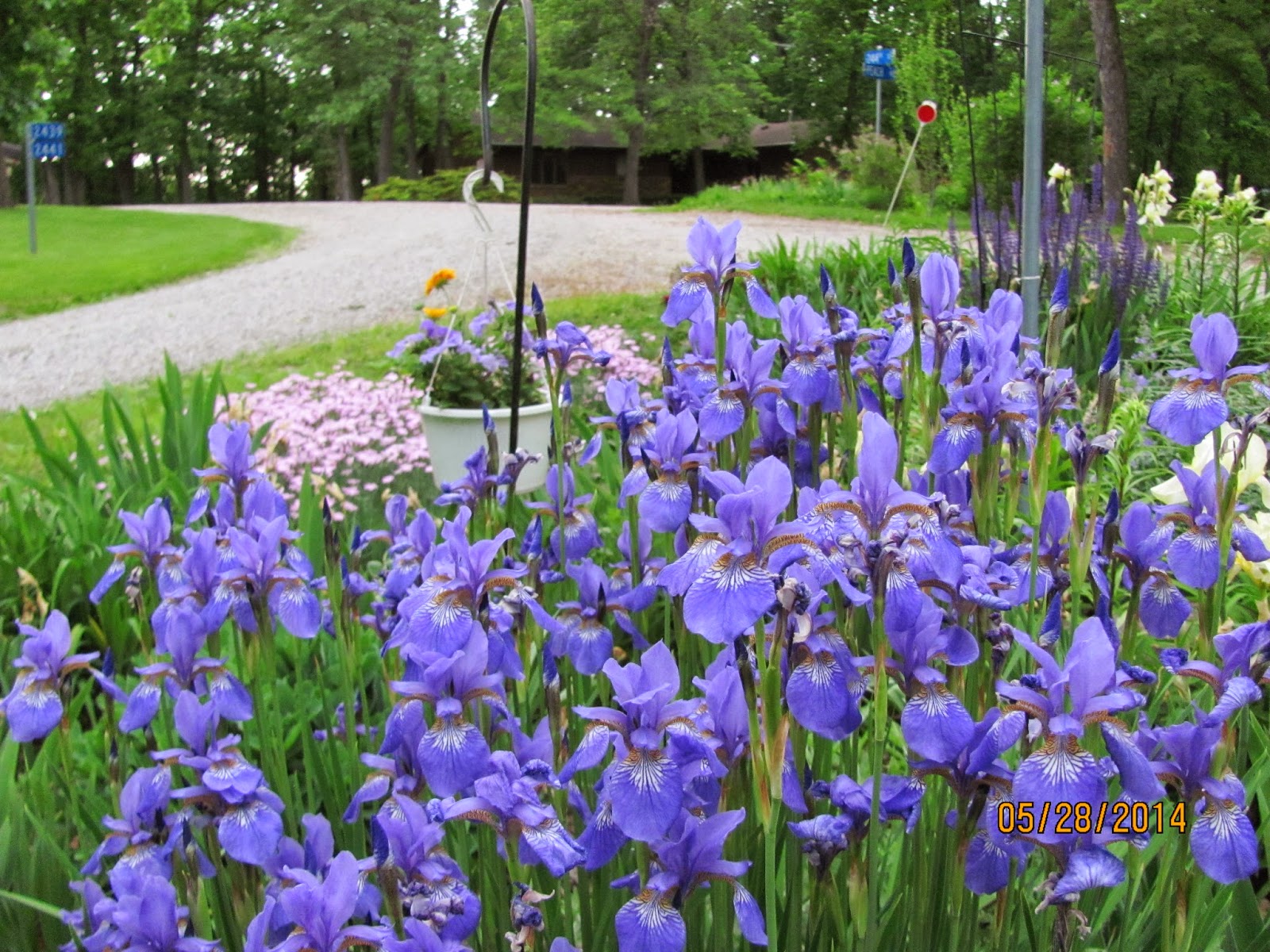
I do have Iris
Iris sibirica - Siberian Iris 'Caeser's Brother' photo taken May 28, 2014
.I have more Iris
Bearded Iris
2014
Sunny Corner Bed
What type of iris is this?
My "Iris I's are Smilin'!"
:-) SG
Wednesday, September 3, 2014
Heigh-Ho! Hostas! ABC Wednesday post
I was once told the Hosta is related to the plantain weed found in the lawn. Because they both have large leaves, I thought it was plausible. However, there's a distinction between the two types of plants: "Click" these words for information from Wikipedia on plantain. Doing a google search will net much more information... we can eat it! :-)
Okay. Back to Hosta! They are often called Plantain Lily; more often in Great Britain than here in the United States . (Comments from my UK friends?)
While opinions differ as to the best time to plant, it seems the easiest to divide older plants in the early Spring, just as the plant begins to show itself. One must make sure to have a root system within each division. I very often plant hosta in early Fall (now!), as there is still time for the root system to establish itself before the weather turns cold.
Did you know that some people believe the hosta is the number one selling plant in the country?
Hosta best enjoy being planted in locations with "deep shade"areas with up to 4 hours of sunlight, but seem to prefer mostly dappled sunlight. Overall, avoid planting in late afternoon direct sunlight. If your hosta receives late afternoon sun but you notice the leaves turning dry and brown, they are probably experiencing sunscald. It generally won't kill them, but it does nothing for their appearance! (The photo below was taken from the University of Minnesota Extension.)
For sunnier sites, plants in the Hosta plantaginea group will fare better, and actually develop more of the fragrant flowers they are known for; ‘August Moon’, ‘Sum and Substance’, ‘Honeybells’ are in this category. Hosta breeders continue to develop new varieties with greater sun tolerance; ‘Sundance’ and ‘Sun Glow’ fit into this category. At the same time these hostas will still tolerate shade, giving gardeners greater flexibility in site location.
Hostas prefer rich, moist soil that is high in organic matter, yet well drained. Adding organic materials such as peat, composted manure, or leaves will help improve soil structure and tilth. That said, hostas are generally adaptable and survive in a wide range of soils, adding to their ease of growing and popularity. Mulching with shredded leaves might invite the slug - a pest that enjoys chomping on hosta leaves!
Hostas require an adequate supply of water to thrive. Hosta leaves have a large surface area and, due to transpiration, lose water easily. If you find yourself needing to water, be consistent with even moisture equaling an inch or so of water per week. Deeper watering done with less frequency is better than frequent shallow applications that do not penetrate the root zone.
Hostas planted in dry shade will need attentive watering; rain does not always reach under eaves of buildings or through tree canopies in sufficient amounts. Planting hostas beneath shallow-rooted trees, such as maples or spruce will require extra watering to both establish and maintain the health of the plant.
You will find hostas that thrive in growing zones 2 through 9. My zone has changed in the past few years from 4 to 5 - a little more "balmy!" ;-)
The next few photos show some of the new varieties I've planted in these last couple of weeks! :-)
Hale and Hearty!
Happy Hosta Lover!
SG
To enjoy more posts in this ABC Wednesday meme, visit by clicking the logo below.
Okay. Back to Hosta! They are often called Plantain Lily; more often in Great Britain than here in the United States . (Comments from my UK friends?)
While opinions differ as to the best time to plant, it seems the easiest to divide older plants in the early Spring, just as the plant begins to show itself. One must make sure to have a root system within each division. I very often plant hosta in early Fall (now!), as there is still time for the root system to establish itself before the weather turns cold.
Did you know that some people believe the hosta is the number one selling plant in the country?
For sunnier sites, plants in the Hosta plantaginea group will fare better, and actually develop more of the fragrant flowers they are known for; ‘August Moon’, ‘Sum and Substance’, ‘Honeybells’ are in this category. Hosta breeders continue to develop new varieties with greater sun tolerance; ‘Sundance’ and ‘Sun Glow’ fit into this category. At the same time these hostas will still tolerate shade, giving gardeners greater flexibility in site location.
The hosta plants below range from mini to small.
Hostas prefer rich, moist soil that is high in organic matter, yet well drained. Adding organic materials such as peat, composted manure, or leaves will help improve soil structure and tilth. That said, hostas are generally adaptable and survive in a wide range of soils, adding to their ease of growing and popularity. Mulching with shredded leaves might invite the slug - a pest that enjoys chomping on hosta leaves!
Hostas require an adequate supply of water to thrive. Hosta leaves have a large surface area and, due to transpiration, lose water easily. If you find yourself needing to water, be consistent with even moisture equaling an inch or so of water per week. Deeper watering done with less frequency is better than frequent shallow applications that do not penetrate the root zone.
Hostas planted in dry shade will need attentive watering; rain does not always reach under eaves of buildings or through tree canopies in sufficient amounts. Planting hostas beneath shallow-rooted trees, such as maples or spruce will require extra watering to both establish and maintain the health of the plant.
You will find hostas that thrive in growing zones 2 through 9. My zone has changed in the past few years from 4 to 5 - a little more "balmy!" ;-)
I'm a Hosta Lover, especially because I have a lot of shade in my backyard. However, hosta enjoy the company of other plants, too!
The next few photos show some of the new varieties I've planted in these last couple of weeks! :-)
Happy Hosta Lover!
SG
To enjoy more posts in this ABC Wednesday meme, visit by clicking the logo below.
Subscribe to:
Posts (Atom)