"I" would like to encourage you to click on the logo above to see the posts by
other bloggers that are participating in this meme.
 Invincible
 - incapable of being conquered, defeated, or subdued.
Invincible describes the Iris.Irritating might also describe the Iris.
When we moved here 8 years ago, the Sunny Corner Bed was completely filled (and overgrown) with Iris tubers. Thus, there were very few blooms. During our second Spring, I dug and dug and dug tubers out of the bed... and gave up. I filled two good-sized boxes and three paper grocery bags full - and gave them away.
I covered the rest of the bed with about 6" of soil, planted other perennials, and covered the bed with 6" of mulch.
The next Spring? Iris were growing through - all over! I dug and pulled, etc. every Spring for the next few years. Finally (8 years later) I think I have a handle on the situation. I did leave two or three spots of iris (dividing and spacing them) that are very pretty - and manageable.
Intermediate Dwarf Bearded Iris
(name unknown - lost tag)
I purchased this iris. It's very pretty, and I need to divide it this Spring.

Bearded iris
(inherited with the property)


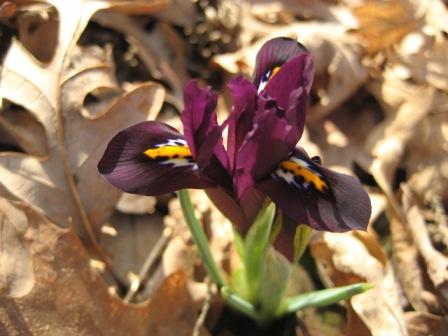
Reticulata irises, Mathew's subgenus Hermodactyloides from western Asia, are another section of bulbous irises. Leaves of this section are grey green and square or almost cylindrical in cross section. Bulbs have netted tunics and the flowers long tubes. They are small plants that are mostly very hardy, flower in early spring and are dormant in summer. They are suitable for rock gardens, bulb frames or alpine houses and should be planted in well-drained soil that can dry out in summer. (I'm guessing all these iris listed below are about 6" tall.)
is from mountain locations in Turkey where it flowers near the snowline. It has bright yellow dotted green flowers with a deep yellow or orange crest. Bulbs need to be planted deeply or they will split into smaller non-blooming bulbs

*Iris 'Sheila Ann Germaney' - is a another desirable hybrid between
Iris histrioides and
Iris winogradowii. It is similar to 'Katherine Hodgkin', but more even pale blue toned and showing less influence of the yellow palette.
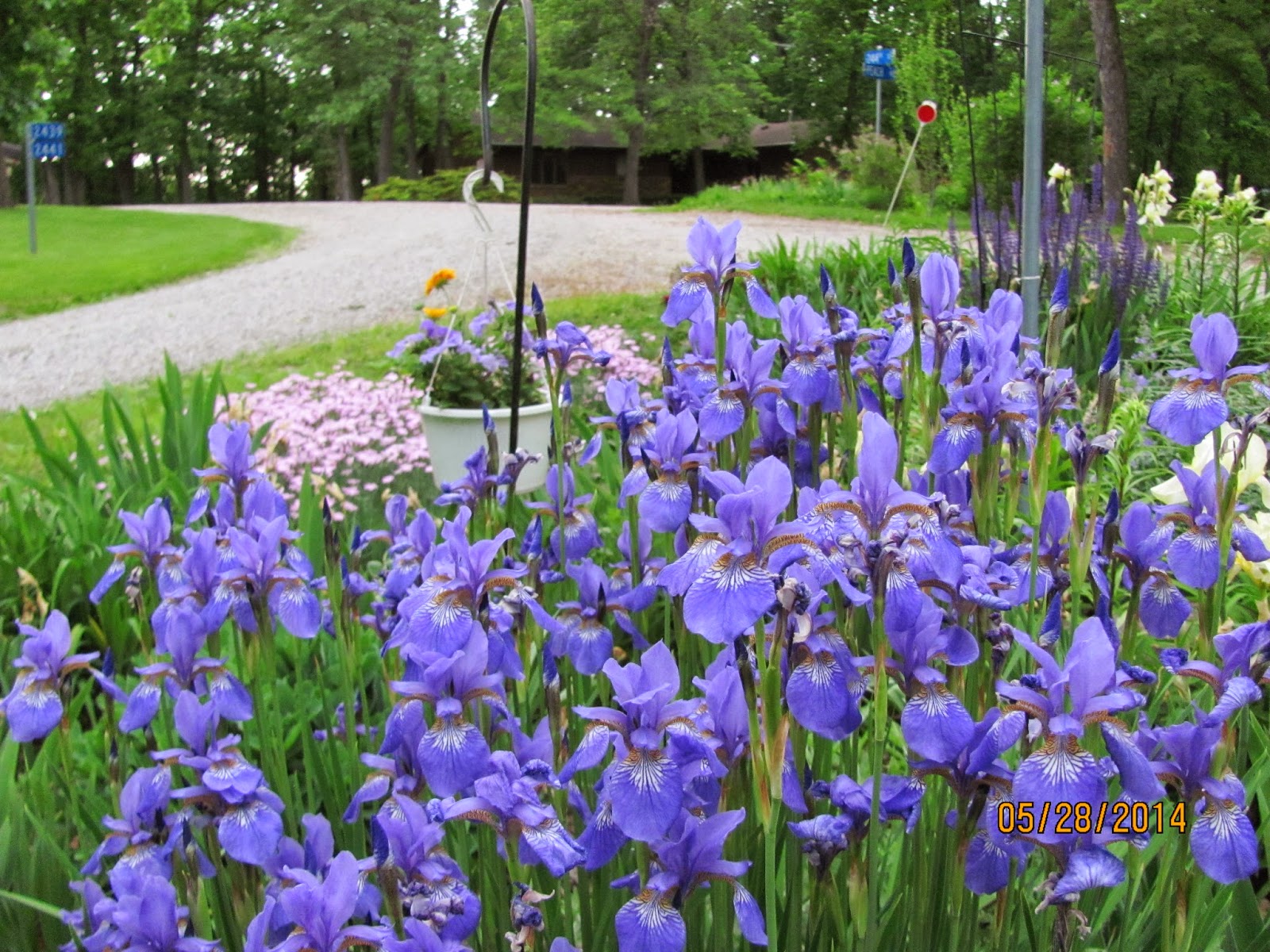
Below: This is a Species Iris of some type - it was in flower beds when we moved here. I don't know what type it is... but I do know that it has a very long, narrow tuber. The tuber continues to grow long and narrow and spread throughout the bed... thus the iris move all over the place. It takes a little time (a couple of years), but you might find them crowding into other plants' territory. (They are beautiful, though, aren't they?)


*Credit given Pacific Bulb Society. Click this link to view other varieties and more information.
this post is property of http://yardisgreen.blogspot.com