Sunday, March 20, 2011

Green Thumb Sunday - Stupendous


It happened!
One amaryllis bulb stays out of the compost pile! :-)

this post property of http://www.yardisgreen.blogspot.com/

Tuesday, March 15, 2011

ABC Wednesday - I is for Invicible or Irritating?

"I" would like to encourage you to click on the logo above to see the posts by
other bloggers that are participating in this meme.


Invincible - incapable of being conquered, defeated, or subdued.

Invincible
describes the Iris.

Irritating might also describe the Iris.

When we moved here 8 years ago, the Sunny Corner Bed was completely filled (and overgrown) with Iris tubers. Thus, there were very few blooms. During our second Spring, I dug and dug and dug tubers out of the bed... and gave up. I filled two good-sized boxes and three paper grocery bags full - and gave them away.

I covered the rest of the bed with about 6" of soil, planted other perennials, and covered the bed with 6" of mulch.

The next Spring? Iris were growing through - all over! I dug and pulled, etc. every Spring for the next few years. Finally (8 years later) I think I have a handle on the situation. I did leave two or three spots of iris (dividing and spacing them) that are very pretty - and manageable.

Intermediate Dwarf Bearded Iris
(name unknown - lost tag)
I purchased this iris. It's very pretty, and I need to divide it this Spring.

Bearded iris
(inherited with the property)


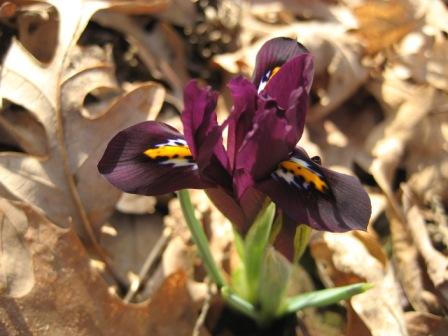
Reticulata irises
, Mathew's subgenus Hermodactyloides from western Asia, are another section of bulbous irises. Leaves of this section are grey green and square or almost cylindrical in cross section. Bulbs have netted tunics and the flowers long tubes. They are small plants that are mostly very hardy, flower in early spring and are dormant in summer. They are suitable for rock gardens, bulb frames or alpine houses and should be planted in well-drained soil that can dry out in summer. (I'm guessing all these iris listed below are about 6" tall.)

*Iris danfordiae is from mountain locations in Turkey where it flowers near the snowline. It has bright yellow dotted green flowers with a deep yellow or orange crest. Bulbs need to be planted deeply or they will split into smaller non-blooming bulbs

*Iris 'Harmony' is a popular hybrid of Iris histrioides and Iris reticulata with a nice contrast of blue and yellow

*Iris 'George' is a hybrid of Iris histrioides and Iris reticulata

*Iris 'Sheila Ann Germaney' - is a another desirable hybrid between Iris histrioides and Iris winogradowii. It is similar to 'Katherine Hodgkin', but more even pale blue toned and showing less influence of the yellow palette.


Below: This is a Species Iris of some type - it was in flower beds when we moved here. I don't know what type it is... but I do know that it has a very long, narrow tuber. The tuber continues to grow long and narrow and spread throughout the bed... thus the iris move all over the place. It takes a little time (a couple of years), but you might find them crowding into other plants' territory. (They are beautiful, though, aren't they?)


*Credit given Pacific Bulb Society. Click this link to view other varieties and more information.

this post is property of http://yardisgreen.blogspot.com

Sunday, March 13, 2011

Green Thumb Sunday

GTS (Green Thumb Sunday) - Something in which I enjoy participating... when I can. :-) Not always is there much blooming here during the Winter. Especially this Winter. However, you'll find a few items below (and can compare a couple of them from last Sunday, as a progress report!).


The two African violets below are the 'Kitchen Window Sill Sitters."
I posted photos of them last week, as they were just beginning to show signs of buds.
Today, one is in blossom. Is it interesting that two petals are smaller than the other three?


This "Christmas Cactus" was moved to the dining room. Pretty.
The first of my big amaryllis bulbs is getting ready to blossom (compare
to last Sunday's photo).

A second amaryllis has two stalks with buds growing...


And this is my ever-blooming begonia - variety unknown.
(I forgot to note the name when I purchased it.)
Looking towards Spring!!

Saturday, March 12, 2011

Silent Saturday


I Missed Wordless Wednesday.
This post property of http://yardisgreen.blogspot.com/

Tuesday, March 8, 2011

ABC Wednesday - Hola to the Honorable Hoya!


ABC Wednesday is a fun meme in which to participate. If you'd rather not participate but enjoy viewing the variety of posts, just click on the link to see who's participating.

Enjoy!


The information in the following paragraph was taken from Wikipedia.

Hoya is a genus of 200-300 species of tropical climbing plants in the family Apocynaceae (Dogbane), native to southern Asia (India east to southern China and southward), Australia and Polynesia. Common names for this genus are waxplant, waxvine, waxflower or simply hoya. This genus was named by botanist Robert Brown, in honor of his friend, botanist Thomas Hoy.


You will find much more information about the species at this site, entitled "The Hoya Page."


During the Fall of 2008 or the Spring of 2009, my Aunt MEA's garden club held a plant sale/fundraiser. My parents and I stopped and shopped. I came home with three hoya leaves in a pot (75-cent expenditure) and hope for its future.

This photo was taken January 24, 2010.
These two photos were taken April 12, 2010. It's growing!


September 1, 2010
A ballet?
March 3, 2011

March 3, 2011
Isn't it looking wonderful? Do you suppose another vine will start?

The Hoya has waxy leaves, and is susceptible to mealy bugs, and certain varieties to spider mites. Treat both by spraying with an insecticidal soap.

Hoyas like bright, indirect sunlight. These plants make great houseplants. I have mine in a bright, west window. You might have to move it around until it finds the "perfect spot."

They tolerate humidity at low levels. If you allow the soil to completely dry between waterings, you will not have to worry about overwatering. When you do water, make sure you water thoroughly - until some water drains through the pot.

You can fertizilize lightly. Once-a-month with a balanced fertilizer is adequate. During the winter, when the plant rests, discontinue feeding.

You can prune when you need to, or after the flowering cycle is complete. The plant blooms on new growth.

This post is property of http://yardisgreen.blogspot.com/

Sunday, March 6, 2011

Green Thumb Sunday

March 6, 2011

The first two violets were begun from leaf cuttings last year. Now look at them!
They're ready to blossom!


This dainty looking violet below was purchased at the grocery store tonight.
I don't know a thing about it - except to say that it was an exceptionally reasonable purchase!
:-)
It's in "isolation" right now - until I know for sure it's not inhabited by critters.

And yes. One of my "Johnny-come-lately" amaryllis bulbs is nearly ready to bloom!

It's just keeping itself out of the compost pile - for one more year! ha.
Actually, the bulb became so healthy last year that it had a baby. I'll leave it in the pot this Summer and remove it next Winter when I give everyone a re-potting.

Just thought you might like to see the greenest of the green here!
Nothing Shady, yet.

Tuesday, March 1, 2011

ABC Wednesday - G is for Grape . . .

Glibly gazing towards Spring...


Grape Hyacinth
Muscari armeniacum
are early Spring blooming bulbs. Those in the photo above are those found occurring naturally. There are several varieties of Muscari - resulting in shades of light blue and white, and cultivars that are light pink/mauve, two-toned blue, etc.

Most bulbs should be planted in zones 3-9. They won't do well in extremely wet or dry conditions. Many of them have a pleasant aroma, that I've not detected. I look forward to having a greater number of them someday - and actually enjoying their fragrance!
They naturalize freely.


I would love to provide you with much more information about this early flowering Spring bulb.
However, this link will give you practically EVERYTHING you'd ever want to know!


*****

Gleefully glazing towards breakfast...


Grape Jelly
(recipe from Practical Kitchen dot com)

5 lbs of grapes
Stem and thoroughly crush fully ripe grapes. Add 2 cups water.
Cover and simmer for 10 minutes.
Extract juice. You will have 6 1/2 cups fruit juice.

Set aside 4 1/2 cups sugar (Do Not Reduce Amount of Sugar)

Combine 1 box light fruit pectin crystals with 1/4 cup of the above sugar.

Slowly add Fruit Pectin mixture to prepared fruit or juice in saucepan. Place saucepan over high heat and stir constantly until mixture comes to a full boil. Stir in remaining sugar. Stir constantly as mixture returns to full rolling boil. Continue to stir and boil hard 1 minute. If sticking occurs reduce heat slightly but maintain the full rolling boil.

Remove from heat. Immediately pour jelly into warm, sterilized jars. Cover quickly with lids, apply screw bands until fingertip tight.

After jars are cool, test for seal. If you press the middle of the lid with your finger, the lid should be firm and curved down slightly in the center. If it springs up, the lid is not sealed. Refrigerate any unsealed jars after 24 hours and use within 3 weeks.

Makes 8 cups of yummy jelly.

(I cannot attest to the quality of this recipe, as I've not tried it - yet.)

*****

And Last but Not Least (!)

Gladly Gravitating to the t.v. re-runs...


Grape Nehi

as loved by Corporal Radar O'Reilly of MASH

You can buy yourself a bottle... just click this link!


Enjoy this little video below as a tribute!


Enjoy other ABC Wednesday posts by clicking this link!

Glad tidings for Giddy moments. ;-)